WORKSHOP
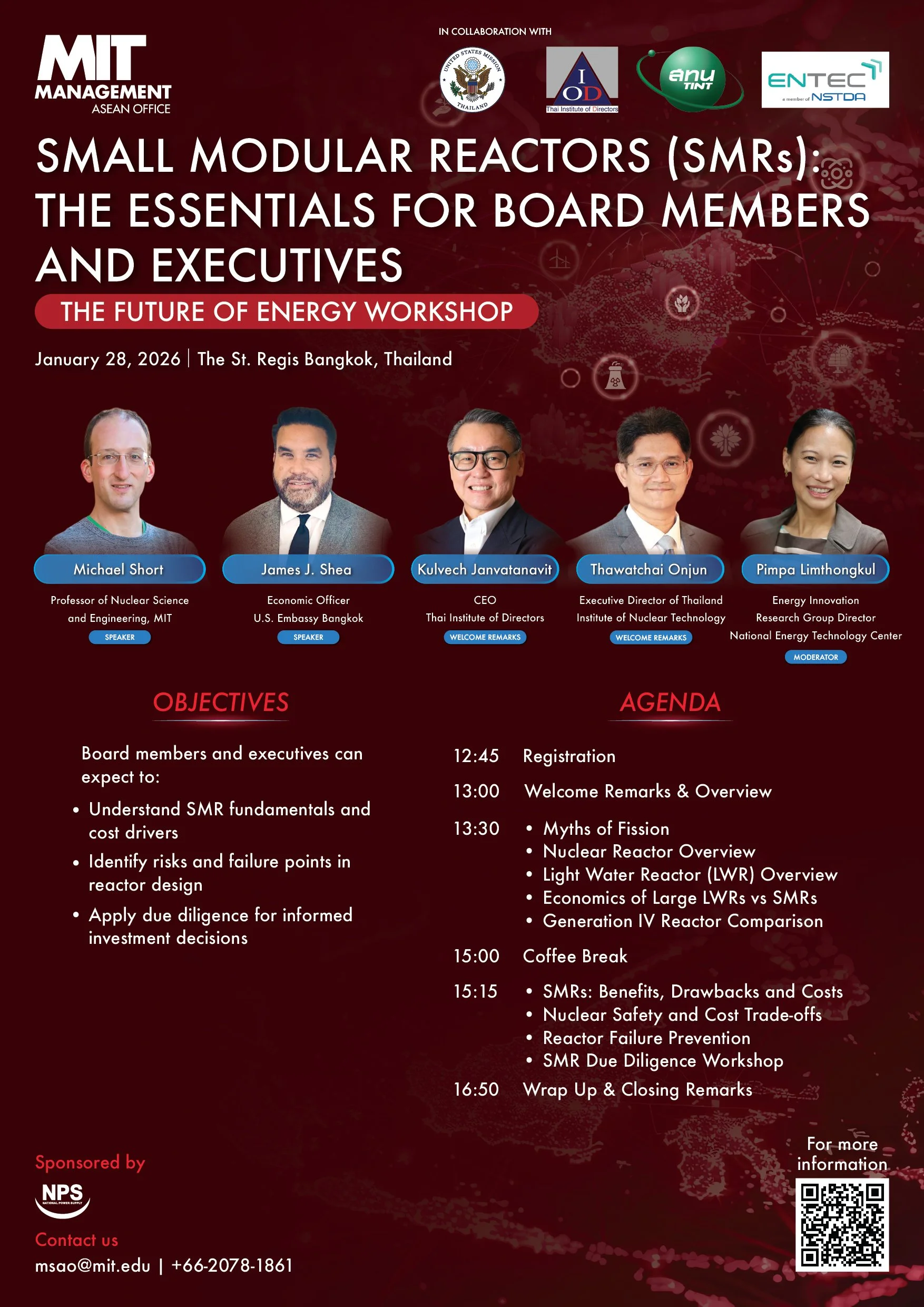
Small Modular Reactors (SMRs): The Essentials for Board Members and Executives
The Future of Energy Series
Faculty Director: Professor Michael Short (SB '05, PD '10, PhD '10, SM '10)
Small Modular Reactors (SMRs): The Essentials for Board Members and Executives
With hundreds of small modular reactor (SMR) and microreactor concepts competing for your time, your funds, and your support, it can be overwhelming to make sense of the specialized and growing world of advanced nuclear power. And yet, judging an economical asset boils down to one word: uptime. Predicting an SMR's uptime, its capacity factor, and therefore the probability of realization of lofty economic promises all depends on its readiness for continued service. This necessitates a system-level understanding about how nuclear reactors work, where their components will be pushed to the limit, and above all else predicting material failure before it happens. Each of us must be able to judge a potential SMR concept and its execution team on merit, not on Powerpoints and promises alone.
In this half-day workshop, Professor Michael Short will give you the tools and information you need to perform adequate technical due diligence on companies hoping to build SMRs on your dime. While our focus will be on fission technology as it is far more near-term, we will draw parallels to similar questions you will get about fusion companies and technologies.
We will begin with an overview of how a generalized nuclear reactor works, followed by a quick survey of where the most expensive up-front costs (CapEx) and operational costs (OpEx) exist by studying the existing light water reactor (LWR) industry. Next, we will do a deep dive into how an LWR works, as many SMR designs are based mostly on scaled-down LWRs. We will discover how energy is extracted, how the reactor is controlled, what types of products it can produce, and how reliably so. Next, we will survey the various advanced reactor concepts through an SMR design oddysey, exploring their unique technical features and challenges, but noting that any one can be safe and economical if run correctly. After all - too much of a virtue can be a vice - and "too safe" means added cost with no tangible benefit.
Next, we will go over the selling points and counterpoints for any particular design, noting that most are either application-specific, or just hype designed to get you to believe most strongly in the technology currently being pitched to you. To counteract this issue, I will go through each of the SMR designs with you, suggesting the types of questions you can ask for your technical due diligence, and examples of good and bad answers to those questions. In this way, without promoting or detracting from any particular company or technology, I will give you the tools and the mindset to properly grill those pushing their reactor technology over others, so you can make the most technically informed decision about the long-term economical viability of a nuclear asset.
Objectives:
Provide foundation knowledge and understanding of SMRs for board members and executives
Provide tools and techniques to help board members and executives on risk mitigation, risk communication and due diligence process
Help executives to make informed decisions on both technical and financial aspects of SMR investment and adoption
Date: 28 January 2026 from 13:00 to 17:00
Venue: The St. Regis Bangkok
Agenda:
13:00-13:30 Welcome and opening remarks
13:30-15:00 The Myths of Fission, and Radiation Facts to Calm the Soul
Overview of a Nuclear Reactor at the System Level
Detailed Light Water Reactor (LWR) System Description - Core, Power Conversion, Safety Systems
Current and Future Economic Assessment of Large LWRs, for Comparison to SMRs to Come
Generation IV (non-water) Nuclear Reactor Comparison with Advantages and Disadvantages of Each
SMR Technology Oddysey, Benefits and Drawbacks of Each Design from a Longevity and CapEx/OpEx Perspective
15:00-15:15 Coffee/Tea Break
15:15-16:45 Defining Nuclear Safety and Its Cost - How Much Is Too Little, and How Much Is Too Much?
How Reactors Fail, and How To Prevent These Failures (keeping your asset economical)
SMR Due Diligence Workshop and Discussion in Small Groups - What Should You Ask, and What Should Answers Look Like?
Group Report-Outs, Overall Discussion
16:45-17:00 Overall Course Summary, Parting Q&A
Audience: 50 participants (board members and high-level executives) from industry, academia, government, and NGOs